


Subscribe
Tags
Voice AI
The Model Context Protocol (MCP) is an open, standardized way for large language models and AI agents to access external data sources, tools, and functions securely and consistently. Instead of building custom integrations for every model and API, MCP provides a universal protocol that lets AI applications fetch context, call structured tools, and interact with external systems in real time. This article explains what MCP is, how it enables richer agent capabilities, and why it matters for developers building scalable AI systems and integrations.
What is the Model Context Protocol?
The Model Context Protocol (MCP) is an emerging open standard designed to help large language models securely interact with external tools, APIs, data sources, and structured prompts.
Put simply, MCP is a protocol for connecting AI models to the outside world, giving them the ability to retrieve data, call functions, use tools, and take actions safely.
The goal is to provide:
A standard way for AI assistants to discover and use tools
A shared language for describing resources, prompts, and capabilities
A developer-friendly architecture for building agent experiences
It’s meant to be a standard interface for connecting AI applications to tools and context, allowing them to take action.
How does MCP work?
At a high level, MCP revolves around three core concepts:
1. Resources
Data sources the model can access (files, databases, APIs). This is how an AI application can fetch relevant context on demand instead of relying only on the model’s prompt window.
2. Tools
Functions the model can call with declared schemas, so server calls are structured rather than freeform.
3. Prompts
Reusable instruction templates the model can invoke to standardize certain interactions or workflows.
This structure allows developers to build integrations where an LLM can follow predictable workflows rather than freeform text generation.
In practice:
An MCP client connects to one or more MCP servers.
Each MCP server advertises what it supports (tools, resources, prompts).
The client can then retrieve resources and invoke tools using MCP’s structured request/response format.
What does the MCP do?
MCP aims to solve foundational problems in modern AI:
Limited context windows
Lack of memory and tool access
Unpredictable, unsafe freeform outputs
No standardized way to give AI models repeatable, testable actions
By formalizing tools, permissions, resources, and structured prompts, MCP attempts to make AI assistant behavior consistent, composable, and interoperable.
Developers have struggled with three recurring problems in AI integrations:
1. Fragmented tool systems
Every AI vendor had its own “plugin” or “function call” format. MCP creates a unified pattern that works everywhere.
2. Hard-to-maintain integrations
When each LLM changes its tool schema, you rewrite integrations. MCP abstracts that churn.
3. Lack of portability
MCP makes tools interoperable across models and ecosystems, improving portability and reuse.
In short: MCP aims to introduce order where the AI tool ecosystem was becoming chaotic.
SWAIG: SignalWire’s production-ready implementation of the AI gateway vision
While the specification is ambitious, MCP carries several limitations. It lacks:
A unified execution runtime
Workflow orchestration
Persistence across sessions
Runtime recovery logic
Real-time telephony or audio streaming
Low-latency conversational AI pipelines
Serverless application hosting
Enterprise-scale routing, events, and state management
This is where the SignalWire AI Gateway (SWAIG) stands out.
Where MCP is a conceptual standard, SWAIG is a fully operational AI Gateway integrated directly into live voice, PSTN, SIP, WebRTC, and SMS flows. It’s already built, deployed, and running at telecom scale.
MCP paints a compelling vision of how AI integrations might work; SWAIG demonstrates how they already do.
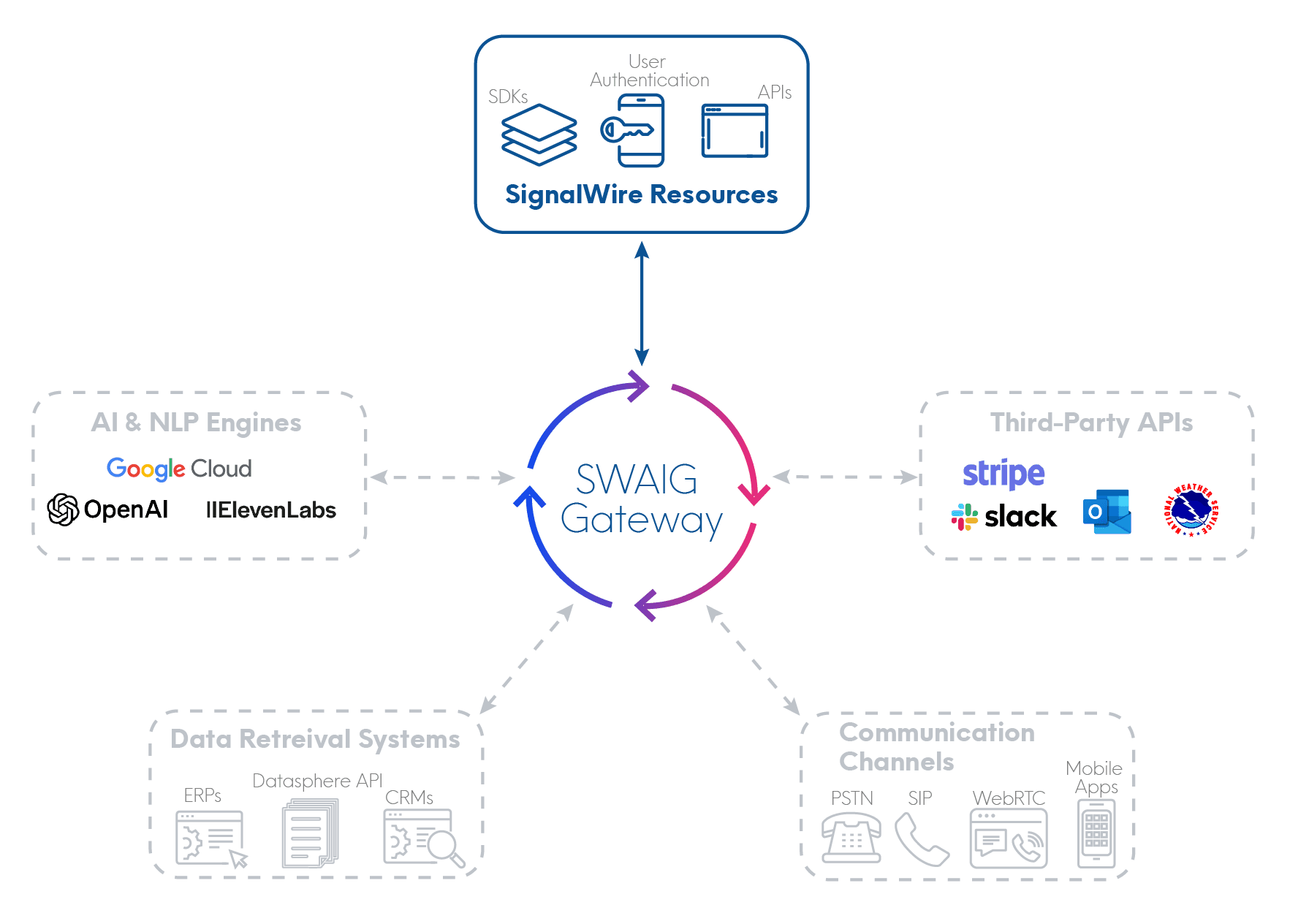
How SWAIG compares to MCP
SWAIG isn't a replacement for MCP. It's built to handle what MCP was never designed for: real-time voice, telephony, and call control. In fact, SignalWire's SDK supports both natively. An agent can expose its own tools as an MCP server for IDE assistants and other agents, while simultaneously pulling in tools from external MCP servers to use during live voice calls. The two work side by side: MCP tools are typically best for data retrieval, while SWAIG handles call-control actions like transfers, holds, and bridging that MCP has no concept of.
SWAIG is integrated with:
PSTN
SIP
WebRTC
Real-time audio
Barge-in
Live session metadata
Telephony controls like transfer/record/hold
And it inherits the reliability of FreeSWITCH, RELAY, and SignalWire’s telecom-grade infrastructure.
MCP defines a model. SWAIG delivers the implementation.
MCP outlines a future where LLMs can interact with external tools through clearly defined schemas, role-based permissioning, and a structured declaration of resources, prompts, and capabilities. It is a strong conceptual framework, but today is better suited for IDE copilots and internal tools than high-volume, low-latency telecom applications.
SWAIG, by contrast, is a production-ready AI gateway system powering real applications across PSTN, SIP, WebRTC, and SMS. The features MCP describes (tool calling, structured arguments, validations, secure function execution, dynamic context, and declarative behavior) already exist in SWAIG with telecom-grade reliability and real-time performance.
Ready to connect your AI agent to external tools?
The MCP is an exciting standard that defines how LLMs should safely interact with external tools, resources, and prompts.
But while MCP is still building toward real-world applicability, SWAIG is already a fully implemented, production-tested AI Gateway, powering real-time agents across PSTN, SIP, and messaging.
If MCP defines the language of future AI integrations, SWAIG is the runtime where that future already works today.
As soon as you leave the IDE and step into production AI, especially voice, telephony, or real-time multi-agent environments, you need much more than a schema. You need an execution environment designed for speed, reliability, and scale.
That’s where SignalWire’s AI Gateway builds on the spirit of MCP and delivers something developers can use to run real, revenue-driving AI systems today. To get started, sign up for a free account, and bring your questions to our developer community on Discord.

Is MCP enough for production AI voice systems?
Not by itself. MCP does not handle real-time audio streaming, call routing, or telecom reliability requirements.
Is MCP production-ready?
While MCP proposes a compelling architecture, its current implementations are early, fragmented, and generally not secure enough for production workloads. Public SDKs and specifications are available, but there is no standardized runtime, no operational guarantees, and no proven deployment pattern for high-trust environments.
Most active MCP implementations are not designed to make real-time decisions, enforce strict execution rules, or manage stateful interactions in customer-facing applications.
Is SignalWire’s AI Gateway an MCP implementation?
SWAIG isn't an alternative to MCP. SignalWire supports both. Agents built on the SDK can expose themselves as MCP servers and consume external MCP servers as tools, while using SWAIG specifically for the real-time call-control actions (transfer, hold, bridge, record) that MCP doesn't define. They're complementary layers, not competitors.
How do I actually use MCP in an application?
Today, MCP is primarily used in developer-focused environments such as IDE assistants, local agents, and experimental tooling. You implement MCP by running an MCP server that exposes resources, tools, or prompts, and an MCP client (usually the model host) that negotiates which capabilities it can access.
In practice, MCP integrations require additional permission negotiation, capability discovery, context handling, and external orchestration to produce runtime behavior.
What alternatives to MCP exist today?
The strongest alternative is a fully realized AI Gateway, a framework that handles not just capability definitions but also execution, safety, state, validation, and real-time operations.
SWAIG is one such alternative. Unlike MCP, which is still conceptual and abstract, SWAIG is a production-grade protocol and runtime that is actively deployed in voice, messaging, and telecom environments. It provides:
Declarative function definitions
Built-in argument validation
Strict action enforcement
Real-time media routing
Serverless or hosted execution
Deterministic behavior inside live sessions
Other developer-centric alternatives exist, but none provide telecom-grade, real-time operational guarantees.
Can MCP support real-time voice or telecom workloads?
No. MCP does not define:
Real-time media handling
Call control
Session context
Deterministic state transitions
Latency requirements
Telephony primitives (DTMF, STT, TTS, routing, etc.)
Its current implementations are unsuitable for environments where milliseconds matter, such as PSTN calls, SIP sessions, programmable voice flows, or cross-channel telecom orchestration.
Related Resources


