Understanding IVA vs. IVR
An intelligent virtual agent (IVA) is an AI-powered software system that handles voice and chat interactions autonomously, resolving customer requests without a human agent. Unlike basic IVRs, IVAs understand natural language, manage multi-turn conversations, and take action inside business systems.
What is an IVA?
An intelligent virtual agent (IVA) is a conversational AI system that communicates with customers through voice, chat, or messaging channels. It interprets intent using natural language understanding (NLU), retrieves information from backend systems, and completes transactions without requiring a human agent.
IVAs are used in:
Voice-based call flows (voice bots)
Chat and messaging automation
Self-service customer support
Agent assist and escalation handling
In a contact center context, an IVA handles inbound calls, outbound notifications, and digital channel conversations. It can authenticate callers, look up account details, process payments, and transfer to a live agent when escalation is required.
IVA vs IVR: what’s the difference?
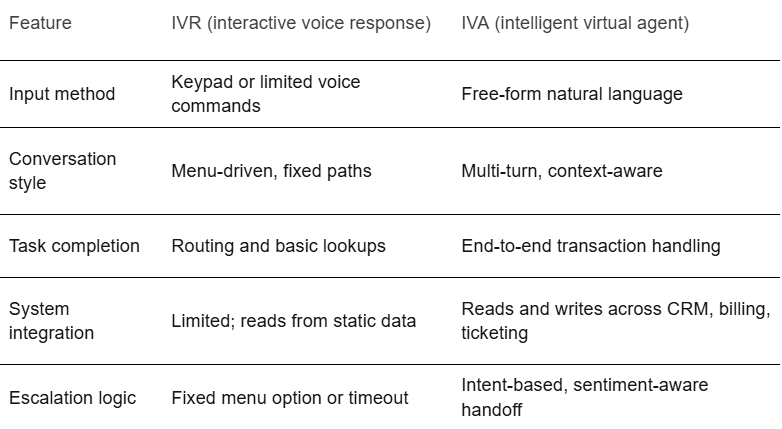
The two terms often appear together, but they describe fundamentally different technologies. An IVR routes callers to the right queue. An IVA resolves the interaction before a queue is ever reached.
How does an IVA work in a contact center?
IVAs combine several AI technologies:
Automatic Speech Recognition (ASR) for converting speech to text
Natural Language Understanding (NLU) to interpret user intent
Dialogue management to maintain context across conversations
Backend integrations with CRM, ticketing, and billing systems
Text-to-Speech (TTS) for voice responses
A production IVA connects three processing layers: the telephony infrastructure that carries the call, the AI runtime that interprets speech and generates responses, and the integration layer that reads and writes business data.
Call arrives. The contact center platform receives an inbound call or triggers an outbound call campaign.
Speech recognition. The IVA converts the caller's audio to text using automatic speech recognition (ASR).
Intent detection. A language model processes the text and identifies what the caller wants.
Data retrieval. The agent calls backend APIs, such as a CRM or billing system, to get account context.
Response generation. The language model produces a reply, which text-to-speech (TTS) converts to audio.
Action execution. If the caller asks to reschedule an appointment or process a refund, the IVA writes back to the relevant system.
Escalation or closure. The call ends with a resolution, a scheduled callback, or a warm transfer to a live agent with full context attached.
Modern IVA platforms run this loop in under 1.2 seconds from the end of the caller's utterance to the start of the agent's reply. Systems built on native telephony infrastructure reach sub-second latency on optimized configurations.
Key capabilities of an IVA
Natural language understanding
An IVA does not require callers to speak in a fixed format. A caller who says "I need to move my Thursday appointment to next week" is understood the same way as one who says "reschedule appointment." The NLU layer extracts intent, entities, and context across turns.
Multi-turn conversation management
Contact center IVAs maintain state across an entire call. If a caller provides their account number in turn one, the IVA carries that context through authentication, lookup, and transaction steps without asking again.
Omnichannel coverage
IVAs deployed on a unified communications platform handle voice, SMS, live chat, and messaging apps through the same logic engine. Agents do not need to be rebuilt per channel.
Real-time agent assist
When an IVA escalates to a human agent, it can simultaneously serve as a real-time assistant, surfacing suggested responses, relevant knowledge articles, and customer sentiment data on the agent desktop.
Outbound engagement
IVAs operate in outbound mode for appointment reminders, payment collection, customer satisfaction surveys, and proactive service notifications. Outbound campaigns use the same agent logic as inbound, reducing development overhead.
Governed AI behavior
Enterprise-grade IVA platforms apply deterministic controls around the language model. The system defines what data the model can see, what actions it can take, and when it must stop and escalate. This pattern prevents hallucinations, out-of-scope responses, and compliance exposure.
Benefits for contact center operations
Higher containment rates
Containment rate measures the percentage of interactions resolved without human intervention. IVAs consistently outperform IVR menus because they handle a wider range of intents and can complete transactions rather than just routing callers.
Reduced average handle time
When an IVA does escalate, it passes structured call context to the receiving agent. The agent skips the re-authentication and re-explanation phase that drives up average handle time (AHT) in traditional contact centers.
24/7 availability without staffing overhead
An IVA serves callers at 3 AM without scheduling, overtime, or training overhead. For contact centers with global customer bases or seasonal volume spikes, always-on AI coverage reduces dependence on extended-hours staffing.
Consistent compliance and quality
Unlike human agents, an IVA applies the same script, disclosures, and data handling rules on every call. For regulated industries such as financial services and healthcare, this consistency reduces audit risk.
Scalable call volume handling
An IVA does not queue. It handles concurrent call volume that would require proportionally more agents in a traditional model. Contact centers using AI handle demand spikes without the lag of emergency staffing.
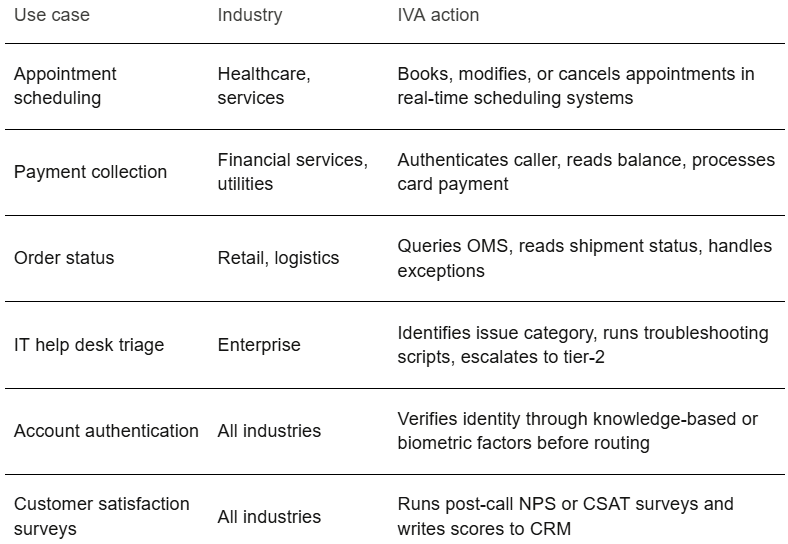
Common IVA use cases
How to choose an IVA platform
The platform you build on determines what the IVA can do, how fast it responds, and how much control you retain over its behavior. Evaluate candidates against these criteria.
Telephony ownership
Platforms that own their telephony infrastructure process audio natively inside the media stack. Platforms that stitch together third-party carrier APIs, ASR vendors, and LLM providers introduce extra hops that add latency and create failure points. For contact center deployments, native telephony ownership is a reliability requirement, not a preference.
AI governance controls
Ask whether the platform lets you scope exactly what data the model sees per call step, what functions it can invoke, and what conditions trigger a forced escalation. Platforms that rely on prompt instructions alone ("prompt and pray") produce inconsistent behavior at scale. Look for platforms where governance is structural, not advisory.
Integration depth
Evaluate the CRM, ticketing, and billing connectors available. An IVA that can read data but not write it completes fewer tasks. Assess whether the platform supports real-time webhook calls during a live conversation with sub-second return paths.
Latency SLAs
Response latency directly affects caller experience. A 3-second pause after a caller stops speaking reads as a system failure. Production-grade IVA platforms publish typical latency figures and allow you to measure them in your own test environment before committing.
Escalation and handoff quality
Evaluate how the platform transfers a call to a live agent. A warm transfer that includes structured context, sentiment signals, and a conversation transcript is significantly more useful than a blind transfer with no metadata. Agents spend less time re-establishing context and more time resolving the issue.
Compliance tooling
For healthcare and financial services, verify HIPAA, PCI DSS, and TCPA compliance at the infrastructure level. Compliance that lives in a prompt is not compliance. It needs to be enforced by the platform.
Build a contact center IVA on programmable infrastructure
SignalWire provides the telephony, AI runtime, and governance controls in one platform. Over 2,000 companies use SignalWire to handle voice, messaging, and AI agent interactions natively, without stitching together third-party vendors. AI agent runtime starts at $0.16/min. Create an account to try it for free and join our developer community on Discord.
Frequently asked questions
What is the difference between an IVA and an IVR?
An IVR routes callers through fixed menus using keypad input or limited voice commands. An IVA understands free-form natural language, manages multi-turn conversations, and completes transactions end-to-end — resolving the interaction before a queue is ever reached.
What infrastructure do I need to build an IVA?
A production IVA connects three layers: the telephony infrastructure that carries the call, the AI runtime that interprets speech and generates responses, and an integration layer that reads and writes business data. Platforms that own their telephony infrastructure natively process audio inside the media stack, reducing the latency and failure points introduced by stitching together third-party carrier, ASR, and LLM vendors.
How do I add governed AI behavior to a voice agent?
Enterprise-grade IVA platforms apply deterministic controls around the language model at the platform level — scoping what data the model can see per call step, what functions it can invoke, and what conditions trigger a forced escalation. This is enforced structurally by the platform, not through prompt instructions alone.
How does an IVA work?
When a call arrives, the IVA converts speech to text, identifies the caller's intent, retrieves relevant data from backend systems, generates a response, and executes any required actions — like rescheduling an appointment or processing a payment. The full loop runs in under 1.2 seconds on production-grade platforms.