
MiniMax
MiniMax is a text-to-speech engine offering expressive voices across many languages, with controls for emotion, speed, pitch, and volume.
Models
SignalWire supports the following MiniMax models. Pick a turbo model for speed and cost, or an
hd model for the highest quality. If you don’t specify a model, speech-2.6-turbo is used.
Voices
Press play to audition any MiniMax voice, then copy config to grab the value for SWML or your SDK.
MiniMax provides a large library of system voices across many languages.
A voice’s Voice ID is what you put in the voice string: for example,
English_CalmWoman becomes minimax.English_CalmWoman.
Only MiniMax’s built-in system voices are supported. Cloned and AI-generated voices do not work — you must use one of the default voice IDs that MiniMax provides.
Some voice IDs contain spaces or parentheses (for example, Cantonese_ProfessionalHost (F)).
Wrap the whole voice string in quotes when a voice ID isn’t a plain word, for example
voice: "minimax.Cantonese_ProfessionalHost (F):speech-2.6-turbo".
Browse the full list of voice IDs in MiniMax’s documentation:
Languages
MiniMax supports the following languages and automatically detects the language of your text:
Arabic, Cantonese, Chinese — Mandarin, Czech, Dutch, English, Finnish, French, German, Greek, Hindi, Indonesian, Italian, Japanese, Korean, Polish, Portuguese, Romanian, Russian, Spanish, Thai, Turkish, Ukrainian, Vietnamese.
Refer to the MiniMax developer platform for the most up-to-date reference to supported languages and voices.
Usage
A voice identifier string has three parts: the minimax engine code, a voice ID, and an optional model.
Format: minimax.<voiceId>:<model>
voiceId(required): a MiniMax system voice ID (for example,English_CalmWoman); see Voices.model(optional): one of the models above. Defaults tospeech-2.6-turbo.
Examples:
You can also set the model with the separate
model
parameter of the languages SWML method
instead of appending :model to the voice string:
Build with MiniMax on SignalWire
Create a Space and add credit
If you don’t have one yet, you’ll need to create a SignalWire Space. Be sure to add some credit to test with.
Add a new Resource
Navigate to the Resources tab in your SignalWire Dashboard and click + Add New to create a new Resource.
Create a SWML Script
From the Resources menu, select SWML Script. Name it something fun and recognizable. Ours is titled MiniMax Wizard.
Next, paste the following starter script into the text box, and hit Save:
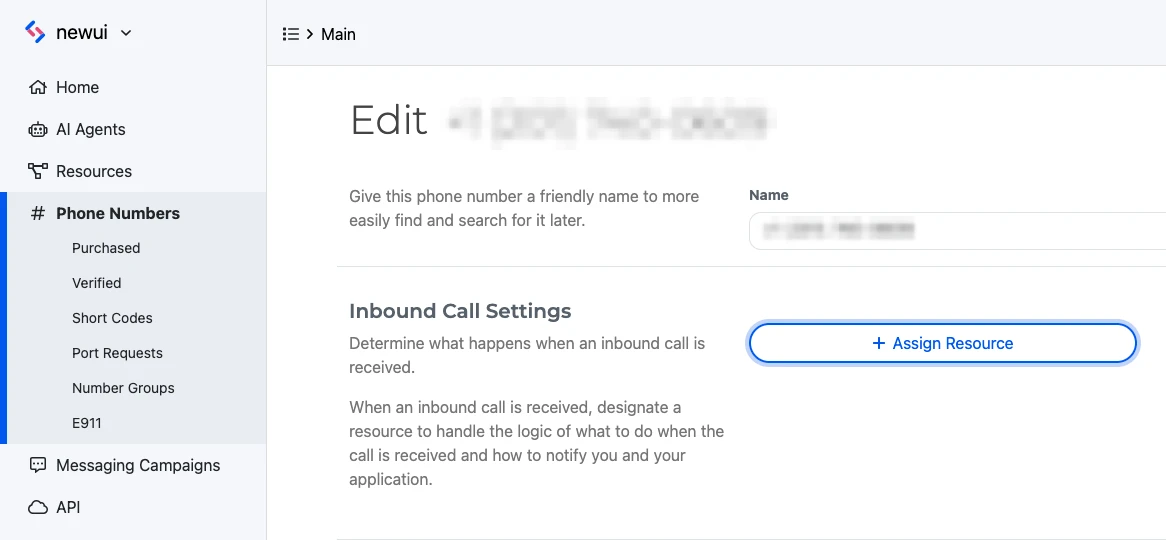
Next steps with SWML
Now you’ve deployed your very first SignalWire voice AI application using MiniMax voices. Next, dive deeper into SWML to explore its capabilities!