
Sending your first SMS
Let’s get you started by sending your first SMS. In this guide we are going to use Compatibility APIs: if you are migrating from a different provider, these APIs will likely be very similar.
Your API Credentials
To send messages, make phone calls, and programmatically control video rooms, you need API credentials. Find these in your SignalWire Space, within the “API” tab on the left sidebar. If this is the first time you are using API credentials, you will need to create an API token.
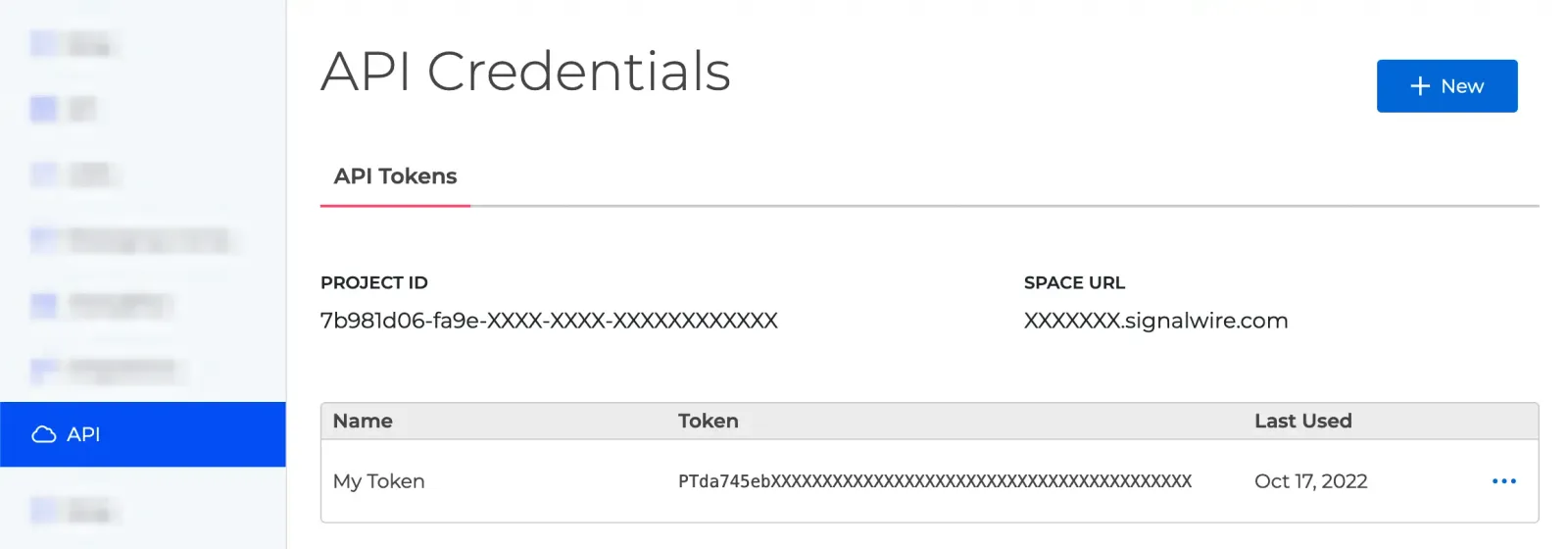
In the “API” section you will find all the information you’ll need. In particular:
- Your Project ID (e.g.,
7b981d06-fa9e-XXXX-XXXX-XXXXXXXXXXXX) - Your Space URL (e.g.,
yourname.signalwire.com) - Your API Token (e.g.,
swapi_da745ebXXXXXXXXXXXXXXXXXXXXXXXXXXXXX)
The API Token is confidential: keep it private.
Obtaining a number
Log in to your SignalWire Space. From the Phone Numbers section, you can buy a new phone number if you don’t have one already. You will need at least one number to send and receive messages.
Make sure the number you are buying supports SMS messaging, and you’re good.
You can also port an existing phone number from another provider.
Sending a message
Let’s see how to send your first message. You have a few different options: you can trigger an HTTP request yourself (using cURL or the dedicated functions in your preferred programming language), or you can use one of our SDKs. We’ll show examples for both methods.
Installation
Once your environment is set up, you can proceed with your first API call.
Sending
To send a message, you can use the Create a Message endpoint from our Compatibility APIs.
If you are sending messages to the US from a 10DLC number, you must register your traffic with the Campaign Registry. Otherwise, the carriers will not deliver your messages. Please see Campaign Registry - Everything You Need To Know for more information.
Let’s see how to send a message with a REST API call:
Make sure to replace all placeholders with your own values.
This example used the Compatibility API, and in particular the Compatibility REST API, to send a message.