Quick Answer: Interactive Voice Response (IVR) uses pre-recorded menus and touch-tone inputs to route calls, while AI phone agents use natural language processing and machine learning to hold dynamic, human-like conversations. AI phone agents resolve issues faster, require no menu navigation, and can handle complex requests, making them the more capable option for modern customer service.
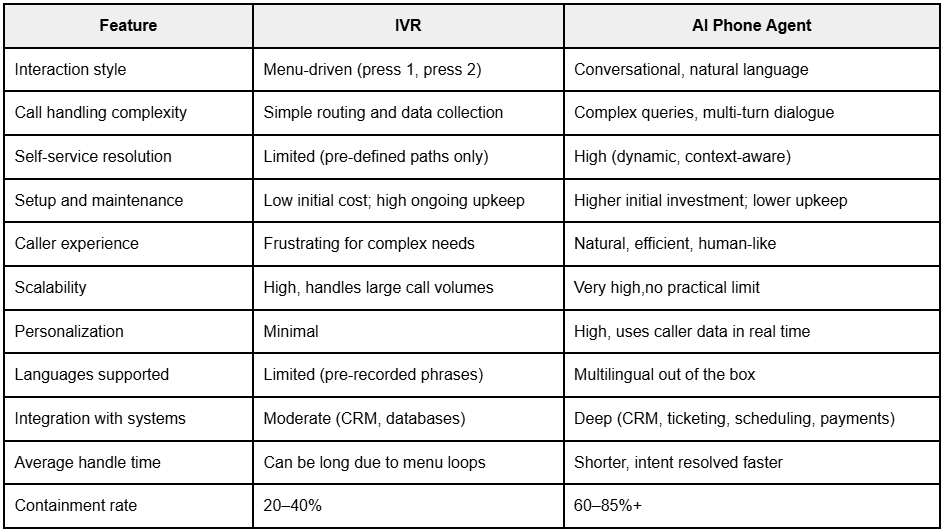
IVR vs. AI Phone Agent Comparison
Interactive Voice Response (IVR) is an automated telephony system that interacts with callers through pre-recorded voice prompts and a menu of options. Callers respond by pressing keys on their keypad (touch-tone/DTMF) or, in more advanced setups, by using basic voice commands.
IVR has been the backbone of call center automation since the 1970s. It routes callers to the right department, collects basic information (like account numbers), and handles simple self-service tasks such as checking a balance or making a payment.
How IVR works:
Caller dials in and hears a greeting with menu options ("Press 1 for billing, press 2 for support…")
Caller selects an option via keypad or voice
The system routes the call or triggers a self-service workflow
If the request is complex, the caller is transferred to a live agent
An AI phone agent (also called a conversational AI agent, virtual voice agent, or AI voice agent) is an intelligent, software-driven system that conducts natural, two-way phone conversations using:
Natural Language Processing (NLP): to understand what callers say
Large Language Models (LLMs): to generate contextually appropriate responses
Speech-to-Text (STT) and Text-to-Speech (TTS): to listen and speak in real time
System integrations: to look up accounts, book appointments, process requests, and more
Unlike IVR, callers don't navigate menus. They simply say what they need in plain language: "I'd like to reschedule my appointment for next Thursday" and the AI handles it end-to-end.
AI voice agent vs. traditional IVR systems: Head-to-head comparison
Key features of IVR
1. Touch-tone and voice navigation
IVR supports both keypad (DTMF) input and basic speech recognition, letting callers select options using their keypad or simple spoken commands like "yes" or "no."
2. Call routing and queue management
IVR identifies the purpose of a call and directs it to the right team, agent, or department, reducing misdirected calls and improving first-call resolution rates.
3. Self-service workflows
Pre-built workflows let callers complete common tasks without a live agent: checking balances, paying bills, verifying order status, or resetting PINs.
4. CRM and database integration
Modern IVR systems connect with CRMs to pull caller data, enabling personalized greetings and account verification before the caller reaches an agent.
5. After-hours automation
IVR operates 24/7, providing basic support and collecting information outside of business hours.
6. Analytics and reporting
IVR platforms track call volumes, drop-off points, menu completion rates, and transfer rates, helping teams identify bottlenecks in the call flow.
Key features of AI phone agents
1. Natural language understanding (NLU)
AI phone agents interpret free-form speech, understanding intent even when callers use informal language, make requests mid-sentence, or change their mind.
2. Dynamic, multi-turn conversation
Unlike IVR, AI agents maintain context across an entire conversation. A caller can say: "Actually, forget that. I'd rather cancel instead of change it," and the agent adapts.
3. Real-time data access
AI agents query live systems during the call, looking up order status, checking availability, reading account history, or processing payments on the spot.
4. Emotion detection and escalation
Advanced AI phone agents detect caller sentiment (frustration, urgency) and intelligently escalate to a human agent when the situation calls for it.
5. Multilingual support
AI agents can switch between languages automatically or handle multilingual conversations without needing separate IVR trees.
6. Continuous learning
AI phone agents improve over time by learning from call data, identifying patterns, and refining how they handle common requests.
7. Full end-to-end task completion
AI agents can complete entire workflows autonomously, booking a service appointment, processing a refund, updating account details, without ever transferring the caller.
Benefits of IVR
Lower upfront cost: IVR systems are widely available, relatively inexpensive to deploy, and supported by most existing telephony infrastructure.
Proven reliability: Decades of use mean IVR systems are mature, stable, and well-understood by IT and operations teams.
High call volume capacity: IVR handles simultaneous inbound calls without degradation, making it suitable for high-traffic environments.
Simple compliance footprint: Pre-recorded interactions are easier to audit and script for regulated industries like healthcare and finance.
Easy to maintain for simple use cases: If your call flows are straightforward and rarely change, IVR is easy to manage and update.
Benefits of AI Phone Agents
Higher containment rates: AI agents resolve 60–85% of calls without a human agent, compared to 20–40% for IVR. Fewer escalations mean lower labor costs.
Better caller experience: Callers speak naturally instead of navigating confusing menus. Satisfaction scores consistently improve when businesses switch from IVR to AI.
Faster resolution: AI agents retrieve information, process requests, and complete tasks in a single conversation, eliminating the back-and-forth of IVR menu trees.
Reduced agent burnout: By handling routine and repetitive calls, AI agents free live agents for higher-value, complex conversations.
Richer data collection: Every conversation generates structured intent data, helping businesses identify common problems, product issues, and service gaps.
Faster deployment of new workflows: Adding a new self-service capability (e.g., handling a new product line) takes hours or days with AI versus weeks with traditional IVR scripting.
IVR vs. AI phone agent: Which should you choose?
Choose IVR if:
Your call flows are simple and unlikely to change
Budget is a primary constraint and call volumes are manageable
Your compliance requirements mandate tightly scripted interactions
You're handling a narrow set of use cases (e.g., a single self-service payment line)
Choose an AI phone agent if:
You receive high call volumes with diverse or complex requests
Caller experience and satisfaction are business priorities
You want to reduce agent headcount or handle more volume without scaling costs
Your customers call after hours and need real resolutions, not just messages
You operate in multiple languages or serve a diverse customer base
Many businesses use both: IVR handles initial routing and simple tasks, while AI phone agents take over for intent recognition, complex requests, and full end-to-end resolution.
IVR is a reliable, cost-effective solution for simple call routing and self-service tasks, but it creates friction for callers with anything beyond basic needs. AI phone agents remove that friction entirely, offering natural conversation, real-time problem resolution, and dramatically higher containment rates.
For businesses prioritizing caller satisfaction, operational efficiency, and scalable growth, AI phone agents represent a meaningful upgrade over legacy IVR. The question isn't whether to make the switch. It's when.
If you’re ready to start building your own AI phone agent, start building with SignalWire and join our developer community on Discord.
Frequently asked questions
Can AI phone agents fully replace IVR?
Yes. AI phone agents can perform every function IVR does — routing, data collection, self-service — and go far beyond it. However, some organizations retain IVR for simple, high-volume tasks at the front of the call flow.
Are AI phone agents more expensive than IVR?
The initial investment is typically higher, but the total cost of ownership is often lower. Higher containment rates mean fewer live agent hours, which usually offsets the technology cost within 6–18 months.
How do AI phone agents handle sensitive data?
Reputable AI phone agent platforms are built with enterprise-grade security, including PCI-DSS compliance for payment data, HIPAA compliance for healthcare, and SOC 2 certification. Data is encrypted in transit and at rest.
What happens when an AI phone agent can't handle a request?
AI phone agents have configurable escalation paths. When a request exceeds the agent's capability or the caller requests a human, the AI transfers the call with full context so the live agent doesn't ask the caller to repeat themselves.