SignalWire Dedicated Real-Time Regions provide single-tenant, geographically isolated environments that anchor live signaling and media traffic within a chosen country or region. Designed for multinational enterprises, they combine predictable low-latency performance with enforceable traffic localization, helping organizations meet governance, compliance, and data residency requirements without building and managing regional telecom infrastructure.
The growing telecom challenge for global enterprises
Multinational enterprises live in a constant tradeoff between performance and governance. Teams need consistently low-latency calling and real-time media features across continents, but compliance, legal, and security requirements mean there’s a need for geographic control over where communications traffic flows.
In practice, many global organizations end up doing the worst of both worlds: they stitch together regional carriers, deploy extra session border controllers (SBCs), and build custom routing and failover logic, only to still see variable call quality, unpredictable latency, and unclear residency boundaries.
The result is a familiar enterprise dilemma: how do you deliver low-latency, high-quality communications globally while keeping traffic localized by country or region, without building a complex telecom footprint in every market?
SignalWire Dedicated Real-Time Regions remove that tradeoff.
What are Dedicated Real-Time Regions?
Dedicated Real-Time Regions route signaling and call media through isolated, single-tenant infrastructure in the geographic region of your choice, offering a significant advantage over standard multi-tenant environments.
They are designed to guarantee real-time performance with:
99.99% availability
Consistent call quality
Reliable mid-call adaptation, including barge-in, live transcription, and agent logic that can respond in real time
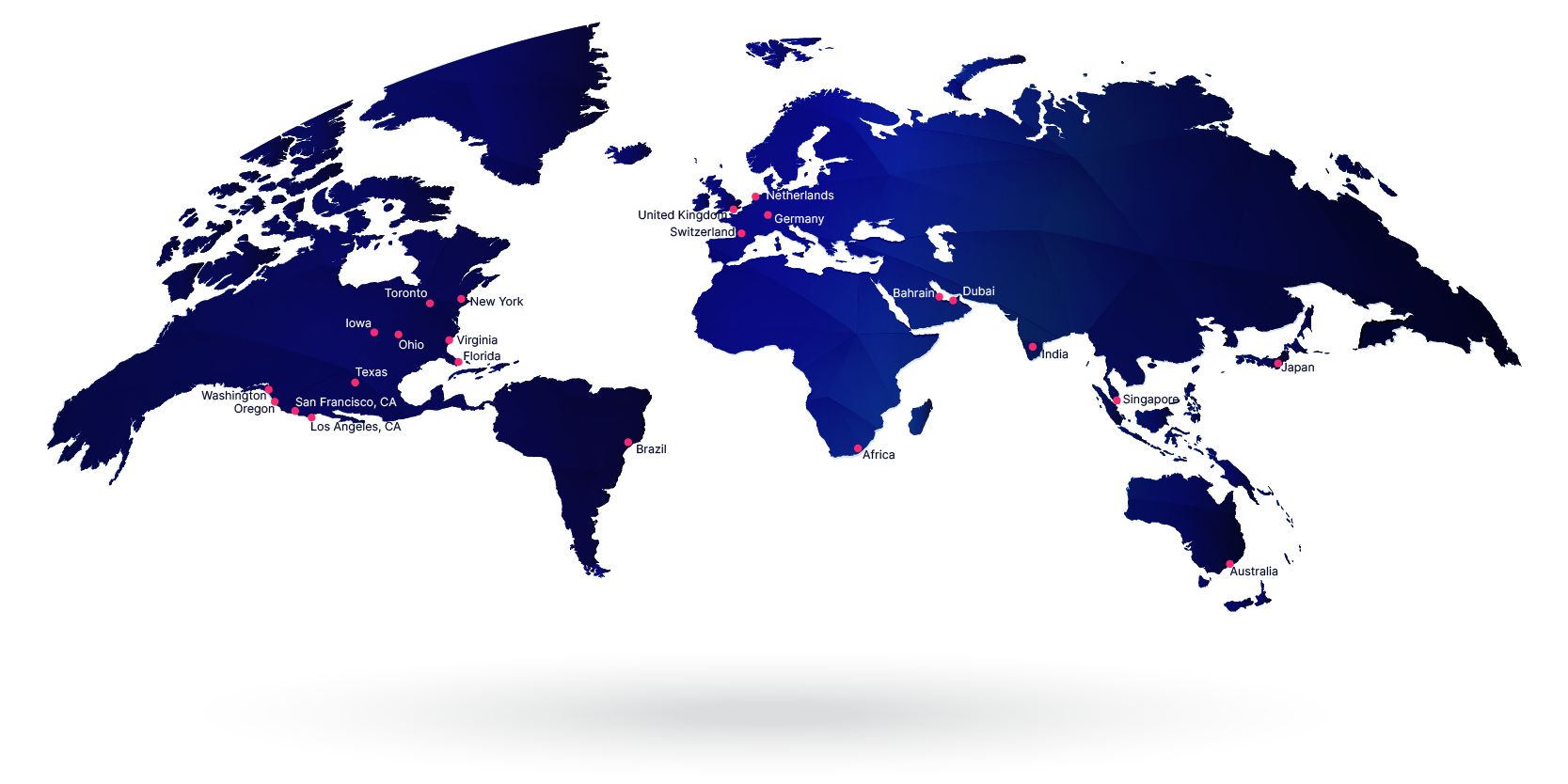
Just as important, they deliver something multinational enterprises often cannot get from regional routing alone: true isolation. Most CPaaS vendors offer multi-region routing, but the underlying infrastructure is typically shared. That means variable performance and limited geographic control because your media path can still traverse shared servers.
Dedicated Real-Time Regions anchor live traffic in a region of your choosing and isolate the media path to your tenant, giving you predictability that shared networks struggle to deliver.
A simple way to frame it:
Traditional hosted VoIP often means rolling out separate regional systems and managing infrastructure and interconnects.
Typical CPaaS regional routing can steer traffic toward a region, but often still runs media on shared multi-tenant infrastructure.
Dedicated Real-Time Regions provide a single-tenant real-time region that localizes signaling and media for your traffic, without requiring you to deploy and operate physical telecom infrastructure in each country.
Shared infrastructure creates unpredictable outcomes. Even when a provider offers “regional routing,” many platforms still run the underlying media path in multi-tenant environments. Performance can vary based on other tenants’ traffic spikes.
DIY regional infrastructure is a hidden telecom project. If you try to solve this yourself, you end up managing SIP proxies, load balancers, TURN traversal, region-specific media servers, and operational runbooks across multiple clouds.
The core issue is that most architectures treat geography as a routing preference, not a hard boundary. Multinational enterprises often need the opposite: a clear, enforceable, country-level anchor for real-time traffic.
Regulatory requirements for multinational enterprises
Country-by-country governance is not optional. Cross-border constraints, data transfer requirements, and industry regulations push many organizations toward localized communications patterns, especially for contact centers, financial services, healthcare, and public sector operations.
Common regulatory headwinds tend to fall into a few categories:
Data localization and cross-border transfer pressure
More jurisdictions are asserting restrictions or requirements around cross-border transfers of data, especially in regulated contexts. Even when the rules are not identical, the operational expectation is increasingly regional: keep sensitive traffic closer to the source, with clear control over routing and handling.
Voice and media are not exempt
It’s easy for teams to treat “data residency” as a storage issue, but real-time communications traffic can also be subject to national regulations and internal governance rules. That includes how media is transported, where it is processed, and what systems it traverses.
Security boundaries and audit expectations
Multinational organizations, especially in finance, healthcare, and government-adjacent sectors, often need tenant isolation, clearer enforcement boundaries, and predictable operational behavior.
This is where many enterprise stacks begin to buckle. The typical “global CPaaS + a pile of regional exceptions” approach can become fragile quickly.
How Dedicated Real-Time Regions enable easier compliance
Dedicated Real-Time Regions provide performance and traffic residency for live communications, without forcing you to build and manage a regional telecom footprint.
Localize live traffic in-region
Dedicated Real-Time Regions anchor signaling and media in the region you choose. This keeps real-time traffic closer to users, reducing round-trip time and supporting in-country or in-region governance requirements for live communications flows.
Centralized control with regional enforcement
Instead of stitching together carriers and regional systems, you keep the developer experience centralized. SignalWire provisions and maintains the environment, and your teams can target the appropriate region while using the same APIs and workflows they already know.
Avoid expensive local integrations
Enterprises often reach for expensive, complex patterns to achieve regional control: separate SIP stacks, region-specific SBC deployments, custom load balancers, and brittle routing logic across clouds. Dedicated Real-Time Regions give you private regional handling without turning your communications stack into a permanent infrastructure project.
Use cases for Dedicated Real-Time Regions
Internal communications between EU and US offices
Global organizations often want internal calling to feel immediate on both sides of the Atlantic, but also want the live traffic path to remain regionally anchored. Dedicated Real-Time Regions support localized real-time handling while maintaining a consistent platform layer for global IT and security teams.
AI agents inside global contact centers
Low-latency voice and AI, barge-in, live transcription, and context switching only feel seamless when media paths are short and predictable. Dedicated Real-Time Regions help ensure the AI behaves consistently in-region rather than feeling laggy or out of sync.
Remote work and hybrid teams with governance requirements
With remote work, “internal comms” no longer means traffic stays inside a single region by default. Dedicated Real-Time Regions give enterprises a way to enforce consistent, testable regional behavior for real-time communications across distributed teams.
Contact centers operating globally with localized media paths
A global contact center may support many countries, but still need per-country or per-region constraints on where live traffic is handled. With Dedicated Real-Time Regions, you can localize real-time traffic by geography while keeping a centralized operational model.
For example, a multinational enterprise has customer support operations in the United States, Germany, and Singapore.
They want:
Customers in each region to experience low-latency, high-quality calls
Real-time features such as transcription and mid-call agent logic to respond immediately
Governance teams to confidently state where live traffic flows
Minimal operational overhead, without deploying separate regional voice stacks
With Dedicated Real-Time Regions, the organization can anchor live traffic in-region. That means signaling and media stays localized to the chosen geography, supporting both performance and residency needs for real-time traffic.
Why Dedicated Real-Time Regions are a better path than building infrastructure
Some enterprises still consider building their own regional telecom footprint to control latency and residency. In practice, that path is expensive and operationally heavy.
Dedicated Real-Time Regions offer a simpler model:
You avoid the capital and operational costs of managing regional voice infrastructure.
Capacity can align to concurrency and reliability requirements without redesigning your architecture each time demand changes.
No standing up separate region-specific stacks, no maintaining SIP proxies and load balancers in every market, no stitching together carriers just to achieve baseline regional control.
Region separation makes performance benchmarking, A/B testing, and failover simulation clearer than shared multi-tenant environments.
Programmable Unified Communications for global enterprises
Most CPaaS providers offer “regional routing” inside multi-tenant deployments. That can be useful, but it does not deliver true single-tenant real-time regions where compute, signaling, and media are isolated per customer.
Many providers can route toward a region. Very few can guarantee that your live traffic is handled inside a private, isolated regional environment. But SignalWire isn’t CPaaS; it’s Programmable Unified Communications (PUC), and that means it can.
Dedicated Real-Time Regions help you:
Keep real-time traffic anchored in the regions that match your governance model
Deliver predictable latency and consistent call quality across geographies
Reduce the operational complexity and compliance risk of patchwork regional infrastructure
And they are also a step toward a more modern PUC approach: real-time communications that can be localized, measured, and controlled globally without turning your stack into a telecom project.
If your organization is operating across borders and real-time quality and governance both matter, Dedicated Real-Time Regions give you a path that is simpler to deploy, easier to validate, and designed for enterprise-grade performance. Contact our team of telecom experts to learn more.
Frequently asked questions
What is a Dedicated Real-Time Region?
A Dedicated Real-Time Region is a single-tenant regional environment within SignalWire that localizes live traffic, meaning signaling and media, to the geography you choose.
Can we deploy Dedicated Real-Time Regions in multiple countries?
Yes. Multinational enterprises often localize communications by region or country to meet governance rules and cross-border transfer restrictions.
Do we need to change our application code to use a Dedicated Real-Time Region?
In most cases, no. SignalWire provisions and maintains the dedicated environment, and you target the region while using the same APIs your team already uses.
What problems do Dedicated Real-Time Regions solve that regional routing does not?
Regional routing often still runs on shared multi-tenant infrastructure, which can introduce variable latency and noisy-neighbor issues. Dedicated Real-Time Regions provide single-tenant isolation for compute, signaling, and media, designed for consistent, measurable performance.