

Subscribe
Key takeaways
Context should travel with the call: verifying callers early and packaging their issue summary before handoff eliminates repeated questions and speeds up resolution
Because SignalWire embeds AI directly in the media layer rather than bolting it onto a legacy stack, you get sub-500ms latency, context persistence, and real-time decision-making
With SWAIG, AI agents become proactive assistants that complete tasks and coordinate with your business systems, not just passive responders
About this webinar
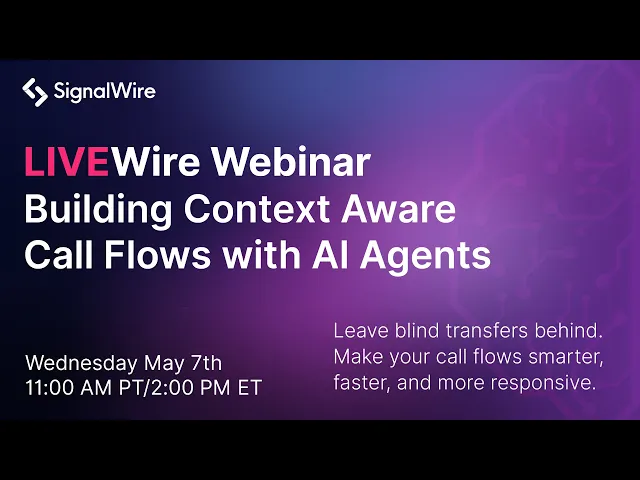
Most voice systems treat every interaction as an isolated event, forcing callers to start over with each escalation. In this hands-on LIVEWire session, SignalWire experts demonstrate how to build context-aware call flows using SWML scripts, AI Agents, the SignalWire AI Gateway (SWAIG), Datasphere, and the Browser SDK. You'll see a full end-to-end demo where an AI agent answers a support call from a browser app, verifies the caller's identity and membership status, summarizes their issue in real time, performs a CRM lookup, and hands the call to a live agent with the complete context displayed in their browser client — before they even say hello.
What you'll learn
Why blind transfers and traditional IVRs erode customer loyalty, and how AI agents modernize the experience
How to define call logic declaratively with SWML (YAML or JSON) and attach AI agents to any callable resource
How to use SWAIG serverless functions to validate callers, query databases, and push context to your CRM mid-conversation
How to layer in Datasphere, SignalWire's RAG API, so agents can pull fresh answers from your knowledge base during a call
How to deflect calls effectively by letting AI triage, resolve simple requests, and escalate with full context intact
Prompt structuring best practices that improve consistency and reduce hallucinations
Speakers

Who is this webinar for?
Developers and technical teams building voice support experiences — especially anyone modernizing an IVR or contact center flow. Familiarity with Python and basic API concepts helps for the demo portion, but the concepts are accessible at any level.
What do I need to follow along with the demo?
A SignalWire account with subscriber authentication enabled, an ngrok account to expose localhost, Python 3.8+, and a SignalWire AI Agent. The full demo code is available in the GitHub repo linked in the session.
What is a context-aware call flow?
A programmable voice workflow where caller information, intent, and prior interaction steps are captured and carried through IVR logic, AI agents, and transfers — so neither the caller nor the receiving agent loses track of what's already happened.
Does this work with existing or legacy phone systems?
Yes. SignalWire AI Agents can recognize and simulate DTMF input, meaning they can navigate external IVRs and capture digits mid-call, making the platform interoperable with traditional systems.
What's the difference between SWAIG and Datasphere?
SWAIG lets AI agents call serverless functions during a conversation — validating accounts, querying systems, pushing data to a CRM. Datasphere is SignalWire's RAG API, giving agents real-time access to your documentation and knowledge bases so responses stay accurate and current.
Related Resources