***
title: Making and receiving phone calls
slug: /guides/make-and-receive-calls
description: >-
Overview of the many ways you can make and receive calls using SignalWire
products.
max-toc-depth: 3
----------------
{/* Links */}
[swml]: /docs/swml "SignalWire Markup Language"
[sw-api]: /docs/apis "SignalWire API"
Follow this guide to make and receive your first phone calls using
[SignalWire Markup Language (SWML)][swml] and
the [SignalWire API][sw-api].
## Prerequisites
To be able to make calls, you will need:
* a SignalWire phone number
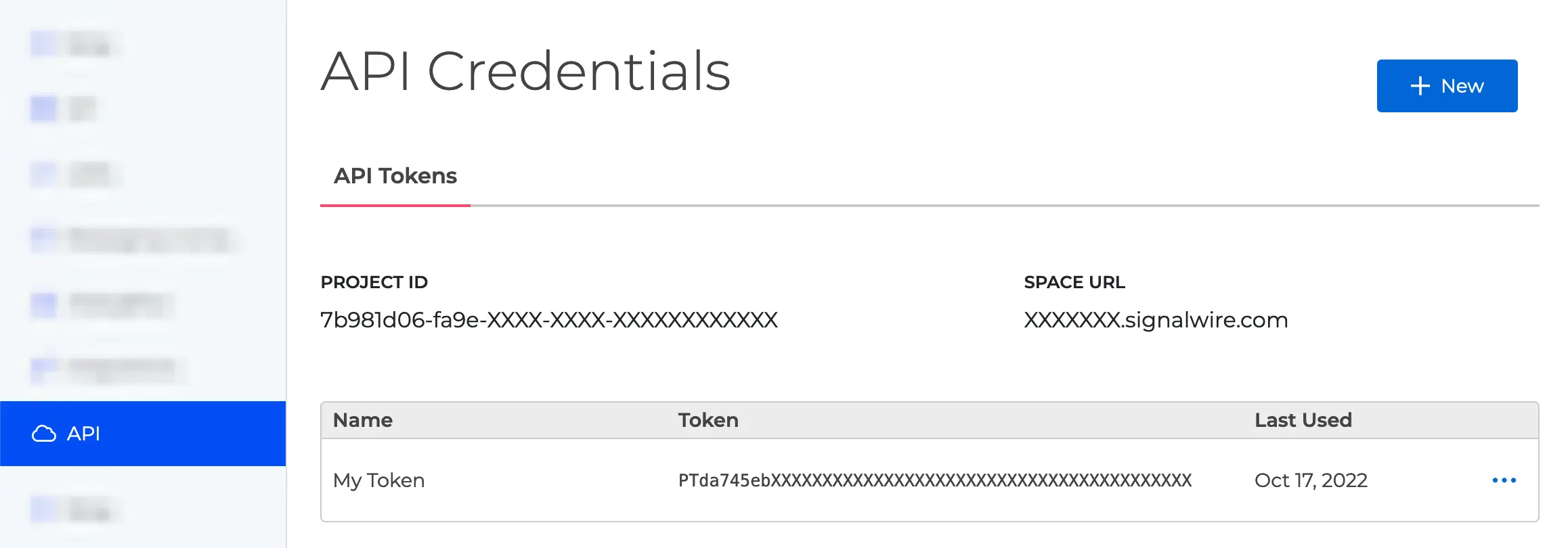
* your API credentials (Space URL, Project ID, and API token)
Also, note that if your account is in trial mode,
you'll need to upgrade it in order to call numbers other than your own verified numbers.
To acquire a phone number,
[log in](https://signalwire.com/signin) to your SignalWire Space.
From the [Phone Numbers section](https://my.signalwire.com/?phone_numbers),
[buy a new phone number](/docs/platform/phone-numbers).
You will need at least one number to make and receive calls.
Find your API tokens in the API section of your Space, as shown below.
You may need to create a new token if you never used one.
Make sure that your token has at least the "Voice" scope enabled.
{/* Shared component: UI Accordion for new vs legacy dashboard */}
**New Dashboard**: You have a **Resources** tab in the left sidebar.
**Legacy Dashboard**: You have separate tabs for SIP, LaML, RELAY, etc.
## SWML
### Receiving incoming calls
To handle incoming calls we need to configure the phone number in our
[SignalWire Space](https://signalwire.com/signin) to answer calls using a SWML Script.
{/* Shared component: Create SWML Script instructions */}
To create a SWML script, navigate to the **Resources** tab in your [SignalWire Dashboard](https://my.signalwire.com), click **+ Add New**, and select **SWML Script**.
```yaml
version: 1.0.0
sections:
main:
- play: say:Hello from SignalWire!
```
Take note of the Request URL for the SWML Script that we created. You can even create a new script if you want to define a different behavior for incoming calls.
To configure your number to handle incoming calls with an SWML Script, click the [Phone Numbers](https://my.signalwire.com/?phone_numbers) section within your SignalWire Space, and edit the settings of the specific number you would like to use to answer calls.
Set **Handle calls using** to **a SWML Script**, then select your SWML Script from the dropdown
That's it! Inbound calls to this SignalWire number will execute the specified SWML Script.
### Making your first call
Outbound calls can be made via the SignalWire REST API's [Create a Call endpoint](/docs/apis/calling/calls/call-commands).
This is accomplished by sending a POST request using SWML in the request body to handle the call.
The SWML can be served via URL or passed inline directly as an escaped JSON string.
```bash
curl -L -g 'https://Your_Space_Name.signalwire.com/api/calling/calls' \
-H 'Content-Type: application/json' \
-H 'Accept: application/json' \
-H "Authorization: Basic $(echo -n "${YOUR-PROJECT-ID}:${YOUR-API-TOKEN}" | base64)" \
--data-raw '{
"command": "dial",
"params": {
"from": "sip:from-sip@example-112233445566.sip.signalwire.com",
"to": "+1xxxxxxxxxx",
"caller_id": "+1234567890",
"fallback_url": "https://example.com/fallback",
"status_url": "https://example.com/status_callback",
"status_events": [
"answered",
"ended"
],
"url": "https://example.com/swml"
}
}'
```
```bash
curl -L -g 'https://Your_Space_Name.signalwire.com/api/calling/calls' \
-H 'Content-Type: application/json' \
-H 'Accept: application/json' \
-H "Authorization: Basic $(echo -n "${YOUR-PROJECT-ID}:${YOUR-API-TOKEN}" | base64)" \
--data-raw '{
"command": "dial",
"params": {
"from": "sip:from-sip@example-112233445566.sip.signalwire.com",
"to": "+1xxxxxxxxxx",
"caller_id": "+1234567890",
"fallback_url": "https://example.com/fallback",
"status_url": "https://example.com/status_callback",
"status_events": [
"answered",
"ended"
]
},
"swml": {
"version": "1.0.0",
"sections": {
"main": [
{
"play": "say:Hello from SignalWire!"
}
]
}
}
}'
```
To pass SWML as an inline string, quotes must be escaped, as shown in the example below.
```bash
curl -L -g 'https://Your_Space_Name.signalwire.com/api/calling/calls' \
-H 'Content-Type: application/json' \
-H 'Accept: application/json' \
-H "Authorization: Basic $(echo -n "${YOUR-PROJECT-ID}:${YOUR-API-TOKEN}" | base64)" \
--data-raw '{
"command": "dial",
"params": {
"from": "sip:from-sip@example-112233445566.sip.signalwire.com",
"to": "+1xxxxxxxxxx",
"caller_id": "+1234567890",
"fallback_url": "https://example.com/fallback",
"status_url": "https://example.com/status_callback",
"status_events": [
"answered",
"ended"
],
"swml": "{\"version\":\"1.0.0\",\"sections\":{\"main\":[{\"play\":\"say:Hello from SignalWire!\"}]}}"
}
}'
```
***
## Next steps
SWML scripts allow you to handle incoming phone calls,
and REST APIs make it easy to trigger outbound calls.
If you need more flexibility and real-time control on your calls,
you may be interested in our guide about how to
[make and receive calls in Node.js](/docs/server-sdk/node/guides/get-started-with-voice).